



Adopting a Project Management Mindset for Better BizOps: How the project management framework improves professional services business operations.
When we bought our house, it was like working a second job: first came the task of finding the house, with Zillow searches and Google street view ‘drive-bys’ followed by actual tours. I worked concurrently with a mortgage broker to get financing lined up, met with our financial planner on budgets, lined up an inspector we could trust, and finally got to the end zone of legal agreements and final papers. People usually tell me how much they dread the house-hunting process, but for me it took me back to my project management days and I actually rather enjoyed it. When your key elements are aligned and moving forward it can be as exciting as any luxury-item shopping trip!
You’ve probably used a project management mindset in your personal life without even realizing it. If you’ve helped a child through the college selection & application process, or managed the extracurricular activities of your children, or even managed a large household, you’re familiar with the concepts.
Most of us in the business operations world don’t think of ourselves as project managers; the project managers are the ones calling on us to help them with approvals, contracts, budgeting and engagement economics. Project management is client-facing, right?
What if we approach our role differently, as if the full lifecycle of BizOps tasks is the project?
The key elements of project management are just as valid on the administrative side:
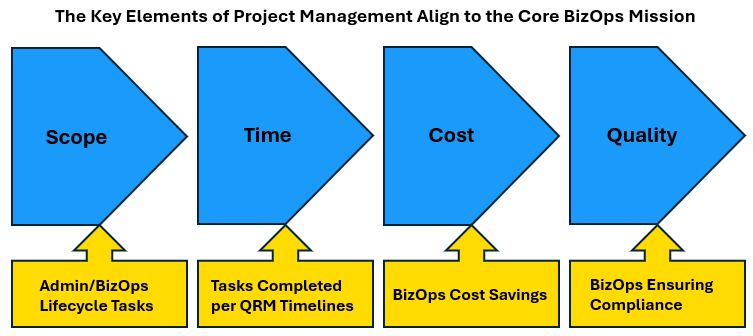
The phases of managing a project have direct correlations to BizOps. The initiation phase for our team is the CRM entry and Client proposal; the Partner enters the CRM opportunity and gets to work on a proposal, usually right after contacting the Client about the work. That CRM opportunity is the beginning of our roadmap, containing everything we need to know to get to work on the approval process to do the work. The opportunity drops into our BizOps work tracker and we start on the approval system, the budget outline and the Statement of Work. Once the Partner provides the proposal we can flesh out the SOW and start to line up what else we’ll need to get the engagement through approvals and into contracting. At this point we’ve moved into the Planning phase of our project, when we’ve assessed our facts and figured out who will complete each task. In our case the team in India plays a huge part in our engagement admin; together we determine what kind of timeframe it’s going to take to get approved, and whether we have additional service line workstreams who need to be looped in to collaborate on the engagement setup.
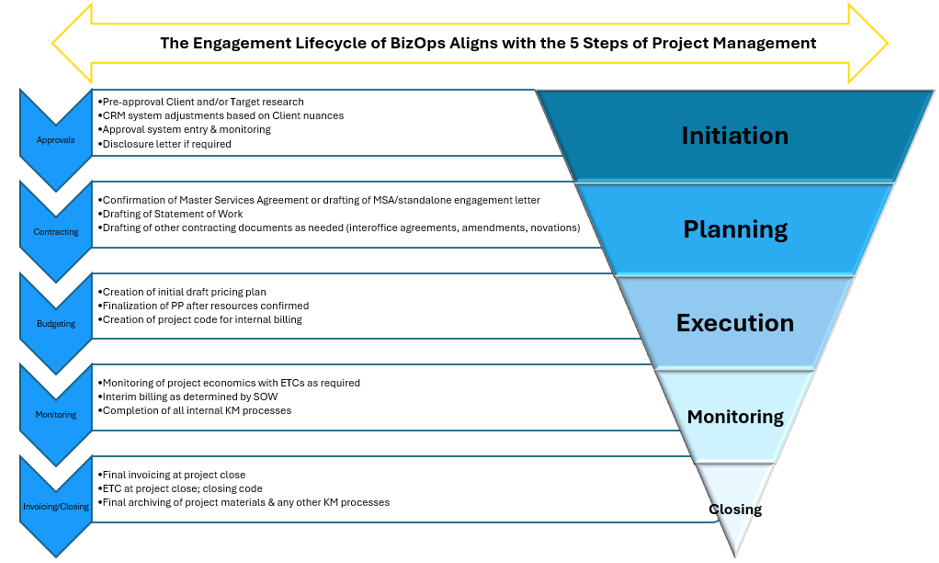
Breaking down the tasks required for project setup and approval, and working out timelines of each step, directly affects when the project can kick off. If one or two tasks that are outside of BizOps’ control go sideways, the whole timeline can be thrown off; it takes foresight, planning and sometimes ‘back pocket’ solutions to keep everything moving.
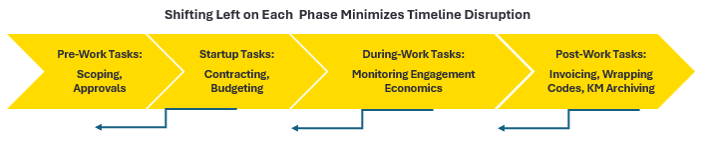
One definitional aspect of project management is ownership: the Project Manager “owns” the project, the success of the project depends on the PM and continued success defines the PM’s career. All too often in business operations we don’t take any ownership. Partners and Managers come to us for administrative help on individual tasks, and once we’ve completed the task we move on. Full lifecycle operations support is about owning the process end to end, planning ahead and accounting for roadblocks that are outside your control. Does your preliminary Client research show you that you’ll need an additional layer of internal approvals? Where can you shift left to make up for the extra day or two you’ll lose while that team does their approval? Are there calls you can make or extra work you can put in to make that approval move faster? What if your India team gets document drafts ready ahead of time, ready for the key scope elements and dates to be added in later? When a BizOps professional is responsible for that project starting on time, staying on top of engagement economics and invoicing promptly after work has wrapped, the client-facing team can focus on the core work product, and valuable time isn’t wasted on process tasks that the team is unaccustomed to. The client team wins because they can focus on what they do best, and the company wins because compliance, risk aversion and financial controls are all managed expertly.
Our team is lucky to have expert programmers who created a bespoke BizOps tracker in Dynamics; there are many off-the-shelf platforms that your team may use for lifecycle task tracking. Our proactive approach wouldn’t be possible without this tool, which allows us to supervise all routine tasks while also noting and monitoring any atypical scenarios. This tool is the equivalent to the project management tools being used on the client-facing side of the aisle, and it allows us to collaborate, manage multiple opportunities at once, and filter for incomplete tasks. When we’re offline our India team can use the tracker to identify their tasks for the day, effectively extending the BizOps day. The role of project manager falls to the US BizOps team member aligned to the lead Partner on the engagement, who then pulls in resources from all related teams (QRM, Finance, GCO) whether via system or in-person, to see the project admin through to completion.
The Execution and Monitoring phases of our project happen in tandem depending on the complexity of approvals and contracting: we execute each task in sequence where QRM requires it, while at the same time shifting left to get started on subsequent tasks. Internal systems may require several different processes to be in play simultaneously, requiring the same level of tracking and monitoring as any task in a client project.
Risk management is especially important in a professional services firm, where conflicts may exist between existing engagements and existing Clients. Part of the BizOps responsibility is mitigating this risk, which requires up-front research and diligence to look for any red flags that may indicate potential conflict. While the QRM/Conflicts team may have the final determination of conflict, it falls on the BizOps team to understand the conflict, draft disclosure letters and ensure that executed letters are attached and filed where needed. Shepherding an opportunity through the full approval process (which may encompass several systems or teams) can be a mini-project in itself, and requires diligent oversight.
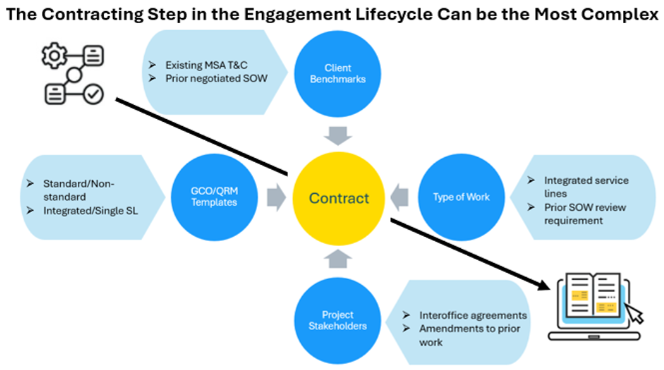
Drafting, reviewing and executing the Statement of Work (SOW) or other ancillary contracts may seem straightforward enough and may be simple with repeat or modular offerings, but the task of contracting alone can involve complexity depending on the client and the service lines involved. Organizations with a sophisticated CLM system may offer structure around contracting, but when counsel on both sides start making changes it’s essential to track versions and record changes. Changes made on one project may affect future projects, so storing the institutional knowledge is essential. The BizOps “PM” is the conduit between GCO templates, approvers, client team and client. No single stakeholder has eyes on the full process as comprehensively as BizOps, and the experiential knowledge gained by working with these templates and client information repeatedly ensures accuracy.
While it may seem like there isn’t a full project team on the admin side of project setup, resource management does come into play when coordinating tasks with offshore colleagues, working with other BizOps colleagues who may be on different workstreams of the same project, and coordinating with the various teams around the firm who have input on conflict, approvals and contracting.
Stakeholder management and Communications are elements of project management that are extremely important in the BizOps role. Providing fully integrated engagement support depends on constant communication with the Partner, project team and key members of the admin groups that can make or break your timeline. Using Teams chats and channels, knowing the key players who can help you expedite urgent or complex tasks, and being resourceful in finding information around the organization will keep your operational gears turning. If we look at the project communications model, we can apply exactly the same to BizOps:
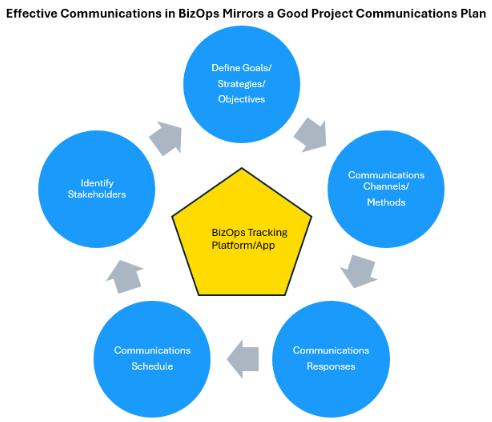
While we may not plan our communications for one particular opportunity, we do follow a model for communicating that works for the Partner and the type of project. Using our tracking tool, whatever platform it may be, we hold regular connects with the Engagement Partner or team PM to give updates on approvals, contracting, project economics, and invoicing, code closures and knowledge transfer at closing. These connects (usually weekly but sometimes more frequent) mimic the team daily standup and follow the same process of systematic review of current state and progress reporting.
The final component of project management that is the most valuable aspect of full-lifecycle BizOps is Integration Management: when the BizOps team is following a tracker, shifting left to deliver documents and start processes before the Partner asks, and pulling together all the various teams that have some part to play in engagement setup, the process goes smoothly with minimal effort on the part of the Partner. This is when BizOps takes on the Chief of Staff role, managing all aspects of the engagement outside of the actual case team work. A well-managed BizOps ‘project’ should feel seamless to the client-facing team. Just as the desired goal of the client-facing work is an effortless set of on-time deliverables, so too is the success of BizOps gauged on being ‘invisible’. The more productive and proactive the BizOps team, the happier the ‘customer’.
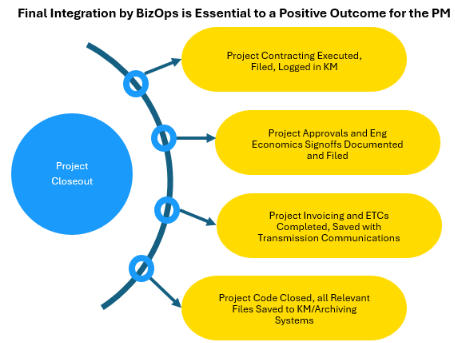
Full lifecycle business operations is all about delivering the objectives (approvals, budgeting, contracting, financial analysis and billing) on budget and on time, and maintaining high levels of stakeholder/customer satisfaction. Embracing the paradigm shift from administrator to project manager elevates the BizOps team to that of a valued advisor, and ensures us a place at the table every time.


.webp)


